


WhatsApp Security Alert: Patch Two Critical Vulnerabilities Now
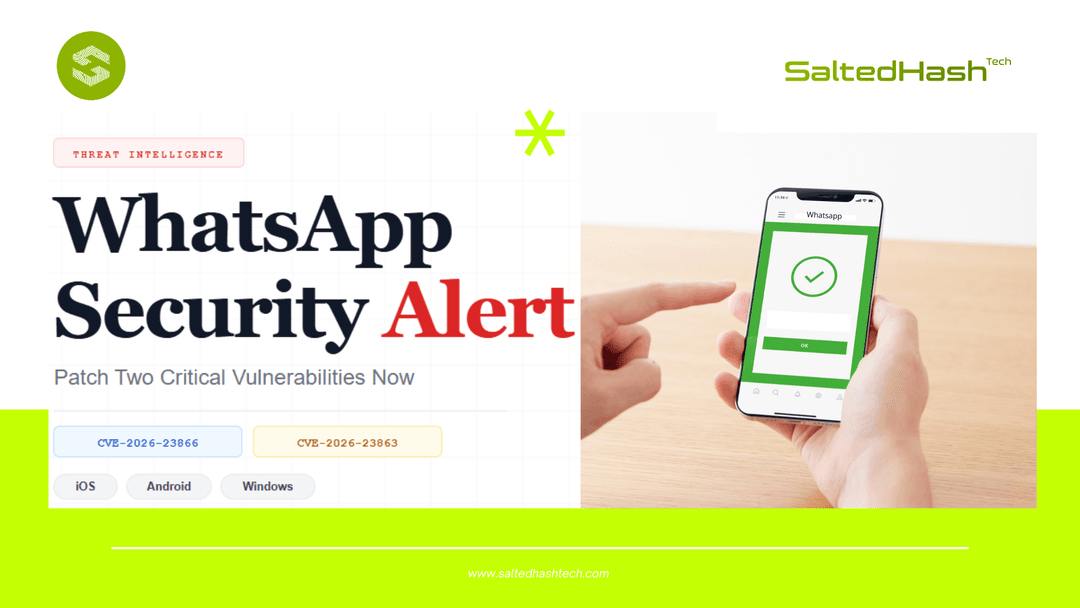
WhatsApp Vulnerability Details:

The Threat: Weaponizing Trust in Messaging
Meta recently issued a critical security advisory for WhatsApp, addressing two distinct vulnerabilities that manipulate how the application handles media and file attachments. While there is currently no evidence of active exploitation in the wild, these flaws significantly lower the barrier for sophisticated social engineering attacks.
If left unpatched, these vulnerabilities could be chained with other system flaws to execute severe, silent compromises on corporate and personal devices.
Issue 1: Media Manipulation via Rich Responses (CVE-2026-23866)
The first vulnerability targets iOS and Android users. It exploits a flaw in how WhatsApp processes AI-generated "rich response" messages that contain embedded Instagram Reels.
Due to incomplete input validation, attackers can craft a malicious message that forces the WhatsApp application to load media from an attacker-controlled URL. In critical scenarios, this bypass can trigger operating system-level custom URL scheme handlers. Simply put: a booby-trapped message could force a user's device to open unauthorized, untrusted content without requiring the user to explicitly click a link.
Issue 2: Executable Spoofing via NUL Bytes (CVE-2026-23863)
The second vulnerability specifically targets the WhatsApp for Windows desktop application (versions prior to 2.3000.1032164386.258709).
This flaw involves the mishandling of filenames that contain embedded NUL bytes. Attackers can leverage this to disguise a malicious executable (.exe) as a harmless document, such as a PDF. When the victim attempts to open what appears to be a safe file directly within the WhatsApp interface, the system executes the hidden payload. This is a classic, highly effective social engineering trap designed to bypass initial user suspicion.
Remediation Guide: Securing Your Fleet
To protect your data and prevent potential code execution, it is imperative to update WhatsApp across all mobile and desktop endpoints immediately.
- For Android Devices: Navigate to the Google Play Store, search for "WhatsApp Messenger," and apply the latest update.
- For iOS Devices: Open the App Store, navigate to your profile to view pending updates, and tap "Update" next to WhatsApp.
- For Windows Desktop: Open the Microsoft Store, navigate to your Library, and click "Get Updates." Verify that your application is updated to version 2.3000.1032164386.258709 or later.
Pro-tip: Enable "App updates" in your Microsoft Store profile settings to automate future patches.

Verify Your Posture
Threat actors continuously exploit trusted communication channels to bypass standard endpoint defenses. Relying on users to spot a spoofed PDF or a malicious rich-text response is a failing strategy.
Are your corporate endpoints vulnerable to file-spoofing and social engineering?
At SaltedHash Tech, we specialize in identifying and neutralizing vulnerabilities before they can be weaponized against your team. From targeted vulnerability assessments to robust employee security awareness training, we build the moats that protect your organization.